
Red light therapy: what’s behind the glow?
A closer look at the results, the device claims, and whether red light deserves a place in your skincare routine.
There’s something appealing about skincare that asks you to sit still for a few minutes. No new serum to work into your routine. No peeling to plan around. Just you, a glowing mask, and the possibility of skin that looks a little smoother and more rested.
Then you start shopping. One device promises collagen. Another promises deeper penetration. Suddenly you’re comparing wavelengths, laser chips, and FDA badges when all you really wanted to know was whether your skin would look better.
Red light therapy has research behind it. The trick is separating what a particular treatment has demonstrated from everything a product page suggests it might do.
Key Takeaways
| Topic | What to know |
|---|---|
| Expected results | Some devices can improve fine lines and texture gradually. Results depend on the device and treatment schedule, and may be subtle. |
| Timing | Think in weeks rather than overnight changes. A home-mask trial found differences in wrinkle ratings from week eight. |
| FDA claims | 510(k) clearance is based on substantial equivalence to a legally marketed device. It differs from drug approval and does not validate every advertised benefit. |
| VCSEL versus LED | A laser light source alone does not establish better skin results. Evidence for the actual device matters. |
| Light output | Wavelength, irradiance, exposure time, and coverage work together. Higher output or longer sessions are not automatically better. |
| Home versus clinic | Some home devices have supporting research, but blanket equivalence to clinic treatments has not been established. |
The sections below explain the research and limitations behind each takeaway.
What is red light therapy actually doing?
Red light therapy is a form of photobiomodulation, or PBM. It uses light at selected wavelengths to influence biological activity. Many skincare devices pair visible red light with near-infrared light, which you cannot see. It is different from UV tanning and from treatments designed to remove or deliberately heat-damage skin.
Researchers are studying how light absorption affects cell signaling, inflammation, and processes involved in tissue repair. Mitochondria, which help cells produce energy, are part of the proposed explanation. But “charging your cells” is a simplified marketing description of a more complicated process. A plausible mechanism helps explain why treatment might work; it cannot tell you how much a particular mask will improve your face. Research on PBM mechanisms1 describes both these pathways and the importance of dose.
Results and realistic timelines: at home or in a clinic

Whether treatment happens at home or in a clinic, realistic goals are gradual improvements in fine lines and texture. Controlled LED research has found benefits with specific treatment protocols, but those findings do not promise the same results from every device.2
A 2025 sham-controlled study enrolled 60 adults to assess a home red and near-infrared mask for crow’s feet. Participants used it for nine minutes, five times weekly, for 12 weeks, with follow-up through week 16. Wrinkle ratings favored the active device from week eight. That supports the potential of home treatment and gives a useful sense of timing, although the findings apply to that particular mask and schedule.3
The study did not compare the mask with clinic equipment, so it cannot establish that the two work equally well. For modest cosmetic goals, a researched home device may be appealing because regular sessions fit more easily into daily life. A clinic offers assessment, supervision, and a treatment plan tailored to your concerns, which can be helpful when you are unsure what your skin needs or are combining procedures.
The setting alone does not determine the outcome. Ask which device is being used, what results its evidence supports, and how many sessions are expected. Also distinguish an in-clinic LED treatment from laser resurfacing: they work differently, and a home red light mask is not an equivalent substitute for a resurfacing procedure.13
Whichever route you choose, think in weeks rather than overnight changes, and follow the device’s instructions. Softer fine lines are a more realistic goal than a lifted jawline or erased scars. Longer-term evidence remains limited, including how long improvements last and which maintenance schedules work best.4
Radiance and irradiance: the glow and the light behind it
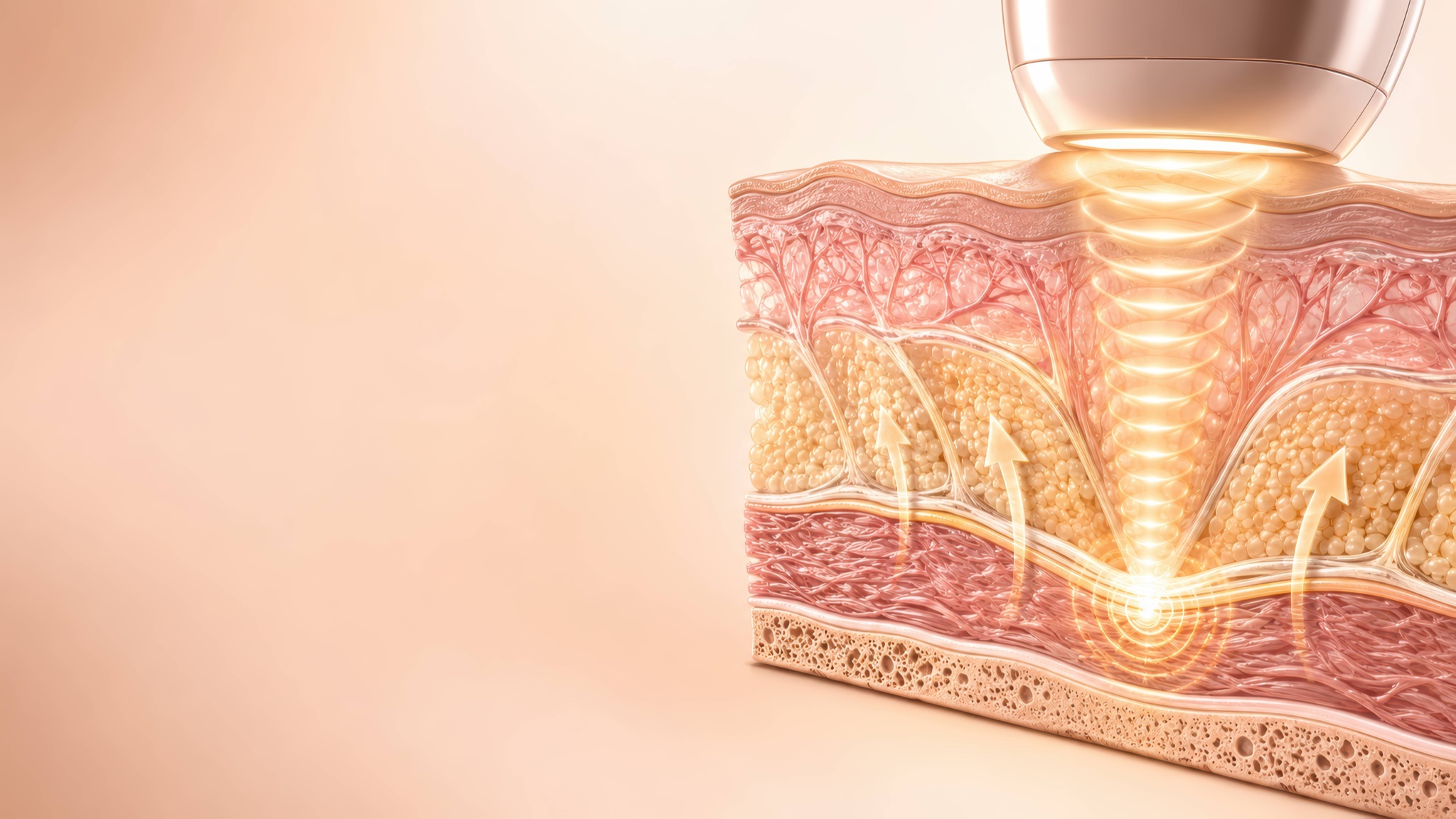
In skincare, radiance describes a brighter, fresher appearance, often associated with smoother texture or more even-looking skin. An immediate glow does not prove collagen growth. Compare photos in consistent lighting over time to judge lasting changes.
Irradiance measures the light power reaching your skin, usually in mW/cm². Combined with treatment time, it determines radiant exposure, or energy delivered per area. Distance, pulsing, and coverage also matter, so a device’s headline output does not tell the whole story.12
A higher number is not automatically better. Too little or too much exposure can reduce the desired response. Look for measurements at the intended treatment distance and follow your device’s directions rather than extending sessions or copying another brand’s schedule.1
FDA cleared is not the same as FDA approved
Seeing “FDA cleared” on a skincare device can sound like the FDA has approved its treatment claims in the same way it approves a medication. But these are different regulatory pathways. A 510(k) clearance is based on substantial equivalence to a legally marketed device. It does not mean the product went through the drug approval process or that every advertised skincare benefit has been demonstrated in clinical trials.
| Term | What it means |
|---|---|
| FDA cleared through 510(k) | FDA determines that a device is substantially equivalent to a legally marketed predicate device, considering intended use and relevant technological characteristics. Supporting data can include performance testing and, when needed, clinical data. |
| FDA approved through PMA | Premarket approval is a different pathway, generally for higher-risk Class III devices. FDA evaluates scientific evidence to determine whether there is reasonable assurance of safety and effectiveness for the intended use. |
| FDA registered or listed | Establishment registration and device listing alone do not mean the device has been cleared or approved. |
These distinctions come from FDA’s explanations of device clearance5, 510(k) evidence6, premarket approval7, and registration and listing8.
Clearance is meaningful, but it is not an endorsement of every sentence in an advertisement or proof that a device outperforms its competitors. It is also not the same as independent, peer-reviewed publication. Ask for the clearance number, check the exact device and manufacturer in Devices@FDA9, and read the intended use. Clearance for one purpose should not be stretched into proof of another.
LEDs versus VCSEL lasers: does the light source matter?
The acronym is VCSEL, short for vertical-cavity surface-emitting laser. It describes a type of semiconductor laser. An LED is a light-emitting diode. Both can supply light for PBM, but they produce and distribute it differently.
Laser light can have a narrower spectrum and more directional output than LED light. Those properties can help engineers control delivery. They do not automatically establish a better skincare result. A research review comparing lasers and LEDs10 describes longstanding uncertainty about how much laser-specific properties contribute to PBM outcomes.
Penetration also depends on wavelength, the skin’s absorption and scattering, and how the device delivers light. The word “laser” cannot supply a universal depth advantage. Nor does deeper automatically mean more useful for the concern you want to treat. A study of light transmission through skin11 illustrates how wavelength, skin color, and tissue thickness affect delivery.
The research reviewed for this article does not establish that VCSEL facial masks, as a category, produce better rejuvenation than LED masks. That gap leaves their comparative benefits uncertain. Before paying a premium, look for a study of the actual device, preferably against a credible comparison treatment, with meaningful skin outcomes. A beam diagram alone cannot show how much your skin will improve.
A few things to check before you switch it on
Follow the manufacturer’s directions, including eye protection requirements. Sunglasses are not a substitute for specified protective goggles. If you have a condition or medication that increases light sensitivity, discuss the device with a clinician first. Skin tone and a tendency toward pigmentation also deserve consideration, and persistent irritation is a reason to stop and get advice. The American Academy of Dermatology’s guidance14 covers these precautions and the remaining questions about long-term use.
Does it deserve a place in your routine?
There is room to enjoy skincare technology without expecting it to do everything. If a researched device fits your budget and you are comfortable with gradual, possibly subtle improvement, red light may be a worthwhile addition.
Before buying, decide what would count as success for you. Smoother-looking texture? Softer fine lines? Then look for evidence that addresses that goal. You deserve a clearer answer than a dramatic photograph and a long list of wavelengths.
Frequently asked questions
How soon should results appear?
Expect gradual changes over weeks of consistent use. The home-mask trial discussed above found differences in wrinkle ratings at eight weeks, but that timeline applies to its particular device and protocol. Follow the instructions for your device rather than increasing treatment time to chase faster results.3
Does FDA clearance mean every benefit on the box is proven?
No. Clearance applies to a specific device and intended use. It does not establish that every marketing claim has been demonstrated in clinical trials, and it is a different pathway from medication approval. Check the device’s FDA record rather than relying on a badge alone.59
Is a VCSEL mask worth paying more for?
The light source alone cannot answer that question. Look for clinical evidence for the exact device and the outcome you want. The research discussed here does not establish a general skincare advantage for VCSEL masks over LED masks.10
Can a home mask replace an in-clinic treatment?
Some home devices can improve wrinkles, but that does not make them equivalent to every professional treatment. Compare the actual devices and goals. A red light mask and a resurfacing laser, for example, have different mechanisms and expected outcomes.313
Will a longer session give better results?
Not necessarily. Dose includes both light output and exposure time, and excessive exposure can reduce the desired response. Use the schedule specified for your device.1
Keep reading
- Infrared saunas and skin health: what the research actually says
- How to build a skincare routine step by step
- How to tell if your skin barrier is damaged (and how to fix it)
References
- Proposed Mechanisms of Photobiomodulation or Low-Level Light Therapy.
- A prospective, randomized, placebo-controlled, double-blinded, and split-face clinical study on LED phototherapy for skin rejuvenation.
- Clinical study to evaluate the efficacy and safety of home-used LED and IRED mask for crow’s feet: A multi-center, randomized, double-blind, sham-controlled study.
- Home-based devices in dermatology: a systematic review of safety and efficacy.
- FDA: Device Approvals and Clearances.
- FDA: Content of a 510(k).
- FDA: Premarket Approval (PMA).
- FDA: Are There “FDA Registered” or “FDA Certified” Medical Devices?
- FDA: Devices@FDA database.
- Photobiomodulation: Lasers vs Light Emitting Diodes?
- Skin color and tissue thickness effects on transmittance, reflectance, and skin temperature when using 635 and 808 nm lasers in low intensity therapeutics.
- Perovskites to Photonics: Engineering NIR LEDs for Photobiomodulation.
- Low-level laser (light) therapy (LLLT) in skin: stimulating, healing, restoring.
- American Academy of Dermatology: Is red light therapy right for your skin?
Sources checked September 26, 2026. This educational article does not replace individualized medical advice.